Service Dog Tasks and the Public Access Test, Explained
This page explains the law in general terms. It is not legal advice. For a specific situation, contact the agency listed on this site or an attorney.
Two ideas sit at the center of service dog training: the tasks the dog performs, and the manners it shows in public. They are related, but they are not the same thing, and neither one is a license or a certificate.
This guide shows how to define service dog tasks, train them with reward-based methods, and use a public access test as a practice benchmark. It also explains where Texas law and the ADA fit in. For the legal side in more depth, see our guide to service dogs in Texas: training, access rights and where they apply.
What counts as a task under the ADA
ADA.gov says service animals are dogs individually trained to do work or perform tasks for people with disabilities. Two phrases matter here: "individually trained" and "work or tasks."
The work or task has to be directly related to the person's disability. A dog that has learned to do something that helps with the disability, on cue or in response to a specific trigger, is doing a task. A dog that is simply pleasant to be around is not.
Examples of tasks by disability
These are common illustrations of the kind of work a trained dog can do. They are not a complete or official list, and each handler's tasks depend on their own needs.
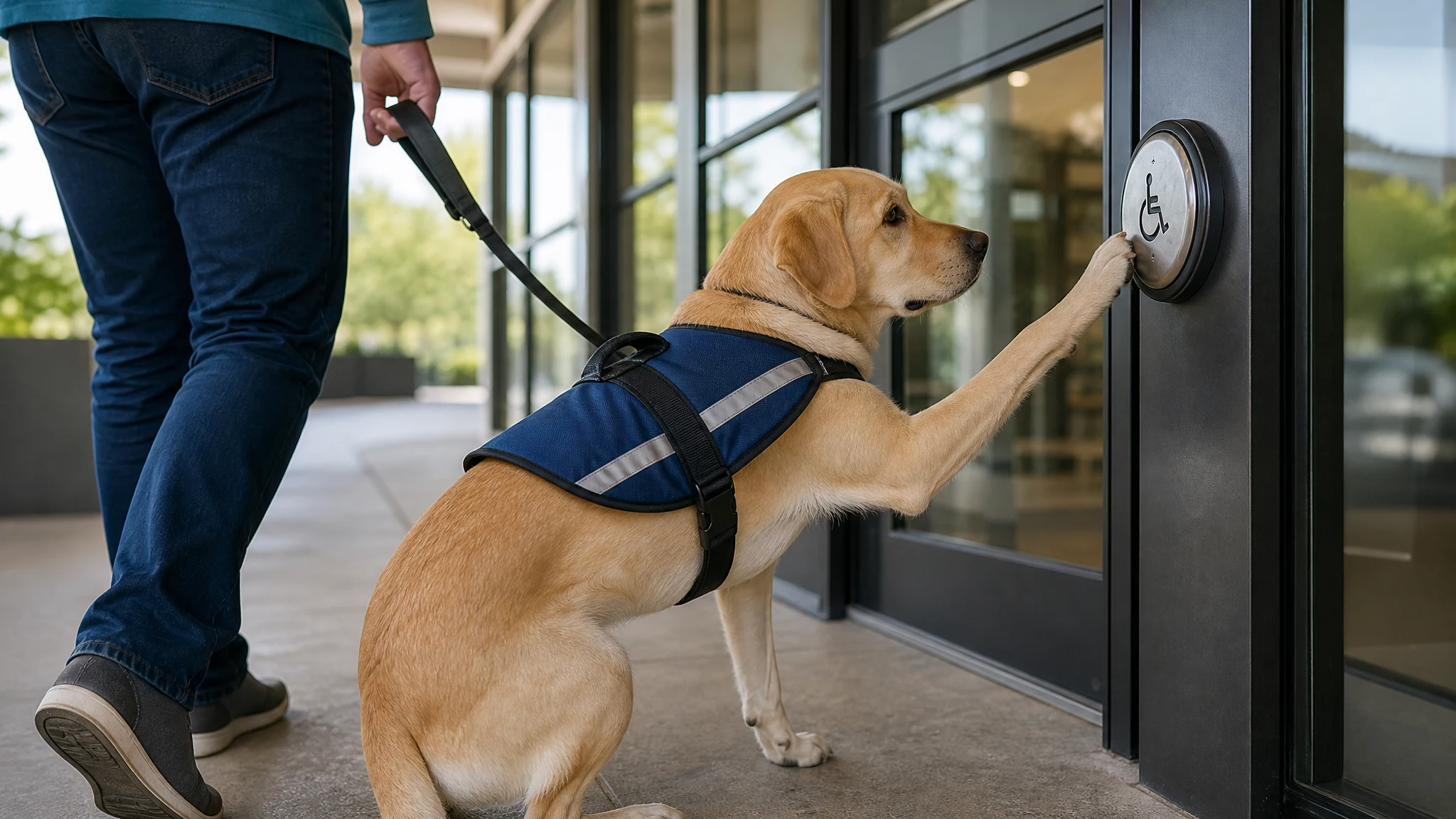
- Mobility disabilities: retrieving dropped items, opening or closing doors, providing bracing support, or pulling a manual wheelchair.
- Hearing loss: alerting the handler to a doorbell, an alarm or a name being called.
- Vision loss: guiding around obstacles and stopping at curbs or stairs.
- Psychiatric disabilities, including PTSD: interrupting a harmful repetitive behavior, creating space in a crowd by standing in a set position, or turning on lights in a room on cue.
- Medical conditions: alerting to a change the dog has been trained to notice, or fetching medication or a phone.
- Autism: interrupting repetitive behavior or keeping a handler from moving into a hazard, depending on the individual.
Texas law is broader than people expect on who may have a service dog. The Texas Legislature, in Human Resources Code chapter 121, says a "person with a disability" expressly includes someone with a mental disability or post-traumatic stress disorder.
Why comfort alone is not a task
Emotional support, therapy and comfort animals are not service animals under the ADA. The Texas Workforce Commission says the same in its brochure on service animal rights: an animal that provides only comfort or emotional support is not a service animal.
The line is exact. A dog that calms you by being near you is providing comfort. A dog that has been trained to perform a specific action when it detects a specific cue is performing a task. Presence, affection and companionship, however valuable, do not meet the ADA definition on their own.
This does not mean emotional support animals have no protections. In housing, they can fall under reasonable accommodation rules in the federal and Texas Fair Housing Acts. That is a separate legal path from service dog access.
The public access test is a benchmark, not a legal requirement
A public access test checks how a dog behaves around people, noise, food and distractions in real places. Assistance Dogs International (ADI), the organization that accredits many assistance dog programs, uses a public access standard for the dogs its member programs place. Check ADI or your program for the official test items, because the details can differ and change.
Here is the important point. The ADA does not require any dog to pass a public access test, and it does not require a certificate. ADA.gov says staff at a business may ask only two questions:
- Is the dog a service animal required because of a disability?
- What work or task has the dog been trained to perform?
Texas follows the same approach. Under Human Resources Code section 121.003, staff may ask only whether the animal is required because of a disability and what work or task it has been trained to perform. The same section bars demands about a service animal's qualifications or certifications.
So why use a public access test at all? Because a dog that cannot behave reliably in public will struggle to do its tasks in public. A test gives you a clear, repeatable way to measure progress. Treat it as a training benchmark, and a way to find gaps before they become problems.
Be aware that an ADA-covered service animal can be removed if it is out of control and the handler does not take effective action, or if it is not housebroken. Good public manners protect the handler's access in practice, even though no test is required on paper.
Materials you will need
- A written list of the disability-related needs the dog will help with, ideally drawn up with the handler's own health care provider.
- Small, soft, high-value treats and a treat pouch.
- A well-fitted flat collar or harness and a standard leash. Avoid shock, prong and choke collars.
- A training log, notebook or app for tracking sessions.
- A phone or camera to film sessions, so you can review timing and body language.
- A clean bill of health from your veterinarian before starting work, and ongoing vet care.
- A list of practice locations that allow dogs for training, with permission where needed.
Step-by-step: train a task and prepare for a public access test
Step 1: Name the need, then choose the task
Start with the disability-related problem, not the trick. Ask what is hard or unsafe for the handler, and what specific action by the dog could help.
Write each task as one clear sentence: "When I drop an item, the dog picks it up and places it in my hand." If you cannot describe the trigger and the action, the task is not defined well enough yet.
Step 2: Check the dog's temperament and health
Not every dog suits public work. A dog that is frequently fearful, reactive or stressed in busy places may not enjoy the job, and that matters for the dog's welfare. Ask your veterinarian about health, pain and fitness for the work. Also consider the dog's age and energy level.
Step 3: Teach the task in small pieces
Use positive reinforcement, in line with the American Veterinary Society of Animal Behavior (AVSAB) position that reward-based training is the humane approach. Break each task into small steps and reward each one.
For a retrieve, for example, you might reward looking at the item, then touching it, then picking it up, then holding it, then delivering it. Keep sessions short, ideally a few minutes, and end on a success.
Step 4: Add the cue and the trigger
Once the dog performs the action reliably, attach a cue word or hand signal. Then work toward the real-life trigger, such as a dropped item or an alarm sound, so the dog can respond without being told in a given moment.
Many tasks need to happen without a cue in real life. Practice the trigger version in several rooms and at different times of day.
Step 5: Build basic manners first
Before heavy public practice, the dog needs a dependable foundation. Common items to build are:
- Loose-leash walking without pulling.
- Sit, down and a settled stay, including under a table.
- Coming when called.
- Ignoring dropped food and other dogs.
- Housebreaking, with a reliable routine for relieving itself.
- Calm behavior around strangers, noises, doors and elevators.
Step 6: Add distractions in small increments
Move practice from your home to a quiet yard, then a quiet street, then a pet-friendly store, then busier places. Raise the difficulty one factor at a time: distance, duration, noise, then crowd size.
If the dog cannot take a treat, shows stress signals or stops responding, you have gone too far too fast. Return to an easier setting and rebuild.
Step 7: Know the Texas rules for dogs in training
Texas gives some access to dogs in training, but with a condition. Human Resources Code section 121.003(i) covers a dog in training only when it is accompanied by an approved trainer. The statute does not define "approved trainer," and the Texas Workforce Commission's own guidance confirms that state law does not define it. It also sets no age, harness or ID conditions.
The ADA does not cover dogs in training. If you are unsure whether you qualify, check with the Texas Workforce Commission or an attorney before relying on access for a training outing. Always get a business's permission if you are not certain.
Step 8: Run a mock public access test
Once the dog is steady, set up a practice run and film it. Ask a helper to score it against a written checklist. Typical areas to review include:
- Entering and leaving a building calmly.
- Walking through a store or hallway on a loose leash.
- Settling in a down-stay while you sit, stand or eat.
- Staying calm when a cart passes, someone drops something or a stranger approaches.
- Ignoring food on the floor.
- Responding to your cue amid distractions.
- Performing one of its tasks in the real setting.
This is your own practice checklist. If you are working with an ADI-accredited program, ask that program for its official test items and standards.
Step 9: Review, repeat and keep records
Watch the video, note what slipped, and go back to the step that needs work. Keep a log of tasks trained, dates and settings. Records do not substitute for legal proof, but they help you see progress and are useful if you ever work with a professional trainer.
Tips and common mistakes to avoid
- Mistake: skipping the task and relying on temperament. A calm dog is not a service dog by that fact alone. The ADA looks for individually trained work or tasks.
- Mistake: buying a registration, ID card or certificate. There is no official service dog registry or required certification under the ADA. Texas has no state service animal ID, tag or registry either. An online registration is not legal proof of anything.
- Mistake: using aversive tools. Shock, prong and choke collars, alpha rolls and scruffing can damage trust and are not part of humane training. Stick with rewards.
- Mistake: rushing public outings. One bad experience in a crowded store can set training back. Go slowly.
- Mistake: training too long. Tired dogs make mistakes. Short, upbeat sessions work better.
- Tip: Teach the dog to settle and relax, not only to work. Downtime matters for the dog's welfare.
- Tip: Practice what you will say if asked the two permitted questions, so you can answer calmly and briefly.
- Tip: Consider working with a qualified, reward-based trainer. Ask any trainer about their methods before you start.
Texas penalties worth knowing
Honesty about what a dog is matters under Texas law. Under Human Resources Code section 121.006, intentionally or knowingly representing that an animal is a service animal when it is not specially trained or equipped to help a person with a disability is a misdemeanor. The fine can be up to $1,000, plus 30 hours of community service. H.B. 4164, effective September 1, 2023, raised that fine from $300, so older web pages may still show the old figure.
On the other side, refusing access to a person with a service animal is a separate offense under section 121.004, with a fine of up to $300 and 30 hours of community service. That section also sets a civil damages presumption of at least $300.
The Texas Penal Code section 42.091 also makes it a crime to attack, injure or kill an assistance animal. Section 121.003(j) bars assaulting, harassing or interfering with one.
Expected results
Progress varies a great deal between dogs and handlers. With steady, reward-based practice, many dogs may become more reliable at their tasks and calmer in public over weeks to months, though some may take longer and some may turn out not to enjoy public work. A mock test can help you see where a dog is likely strong and where it may need more practice.
Passing your own practice test does not create legal status, and it does not guarantee a smooth outing every time. Treat the result as information, not a verdict.
Where to go with questions or complaints
This article explains the law in plain terms and is not legal advice. For housing or employment discrimination, the Texas Workforce Commission Civil Rights Division handles complaints and can be reached at 512-463-2642. For a refusal of access in a public place, the Texas Workforce Commission says there is no state administrative agency in chapter 121. A person denied access may sue for damages under section 121.004(b). It also says to report misrepresentation to local law enforcement and abuse or neglect to local animal control.
Sources
- ADA.gov, ADA Requirements: Service Animals
- ADA.gov, Frequently Asked Questions about Service Animals and the ADA
- Texas Legislature, Human Resources Code chapter 121
- Texas Workforce Commission, Rights and Responsibilities of People Using Service Animals
- Texas Workforce Commission, Civil Rights Division
- Texas Penal Code section 42.091